The sites The street everyone walks
Curetes Street: The Marble Spine of Ephesus
Every tour that starts at the Upper Gate ends up on the same marble street, heading downhill toward the Library of Celsus. Most people remember the view and forget what they walked past. Here is what lines it, stop by stop.
The short answer
Curetes Street is the paved marble street that runs downhill through the heart of Ephesus, from the Hercules Gate at Domitian Square to the Library of Celsus. Along it stand the Fountain of Trajan, the so-called Temple of Hadrian, the Baths of Scholastica with the public latrines, the entrance to the Terrace Houses and the Octagon. The standard Ephesus ticket covers the street; the Terrace Houses need their own ticket.

- Runs from
- the Hercules Gate at Domitian Square
- Runs to
- the Library of Celsus
- Name
- from inscriptions of the Curetes found on the street
- Main stops
- Fountain of Trajan, Temple of Hadrian, Baths of Scholastica, latrines, Terrace Houses
- Direction on most tours
- downhill, after entering at the Upper Gate
- Ticket
- standard Ephesus ticket; Terrace Houses separate
What is Curetes Street?
It is one of the main streets of ancient Ephesus, the sloping marble road that carries you from the upper city down to the Library of Celsus. It runs through the valley between the city's two hills, Bulbul Dagi and Panayir Dagi, and it is paved with slabs of limestone and marble.
Look at a plan of the city and you will notice something odd: most Roman streets in Ephesus meet at right angles, but this one cuts across them at a slant. Archaeologists think that is because it is older than the grid and because religious processions used it, so the city built around its line rather than straightening it. In Roman times its upper stretch was lined with colonnades and shops, with the houses of wealthy families on the slope above, while its lower stretch held fountains, a temple, baths and monuments to the city's leading families.
An earthquake in the fourth century AD damaged the street badly. Much of what you see standing today was set back up by Austrian archaeologists in the twentieth century from the blocks they found lying here.
Where is Curetes Street on a map of Ephesus?
In the middle of the site, linking the upper city to the lower city. If you enter at the Upper Gate, as most guided tours do, ours included, you cross the State Agora, reach Domitian Square and then turn downhill onto Curetes Street. These are its main stops in the order you meet them:
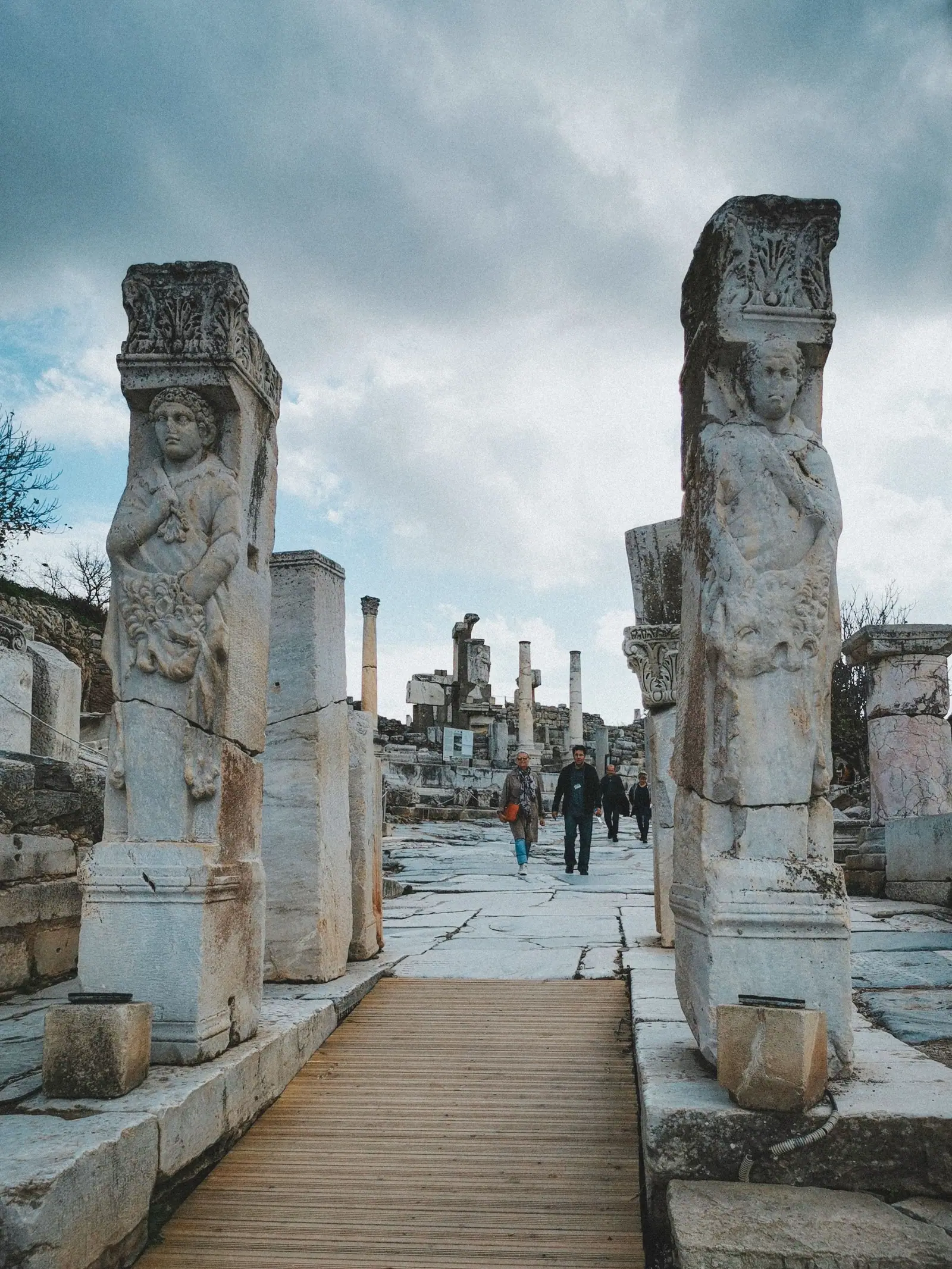
- the Hercules Gate, two pillars carved with figures of Hercules, with the winged Nike relief nearby
- the Fountain of Trajan, a rebuilt corner of a two-story fountain facade
- the Temple of Hadrian, with the Baths of Scholastica and the public latrines behind it
- the entrance to the Terrace Houses, on the slope opposite the temple
- the Octagon and the Heroon of Androklos, near the lower end
- the Gate of Hadrian, and then the Library of Celsus, where the street ends
Just above the start of the street, on Domitian Square, stand the Memmius Monument and the terrace of the Temple of Domitian. Our walk through Ephesus puts the whole site in order, gate to gate.
Planning the day? Match a tour to your hours ashore
-
Time in port: Under 5 hours ashore
The Open-Air Circle
No tickets and almost no walking: Artemis, Selcuk and a drive past the ruins.
Tour length: 3-4 hours
-
Time in port: 5 to 8 hours
Just Ephesus
Ephesus from the Upper Gate down to the Lower Gate, and back with time to spare.
Tour length: 3-3.5 hours
-
Time in port: 8 to 9 hours
Marble, Mosaics and Artemis
All of Ephesus, the Terrace Houses and the Temple of Artemis.
Tour length: 5.5-6.5 hours
-
Time in port: 9 hours or more
The Road of Paul and John
Ephesus, the House of the Virgin Mary, St. John and Artemis.
Tour length: 6-7 hours
-
Time in port: Late arrival, tender or tight call
All-Aboard Ephesus
We plan backward from all-aboard and fit in only what fits.
Tour length: Fits your call
-
Time in port: You have your own list
Your Ship, Your Day
Tell us your ship and your wishes; we build the day around both.
Tour length: Fits your call
Every tour is private and priced from €33 per person for groups of 8 or more; smaller groups get a private quote. Any group size: 1 to 52 people per coach, and more coaches for larger groups. Entrance tickets are extra, at the official price.
Why is it called Curetes Street?
Because of the inscriptions found on it. When archaeologists cleared the street, they found inscribed blocks naming the Curetes, a college of priests and officials tied to the cult of Artemis. Those blocks had first stood in the Prytaneion, the city hall up beside the State Agora, and had been reused down here. The modern name stuck.
What the Ephesians themselves called the street is less certain. Scholars think it was probably the Embolos, a Greek word for a wedge, or simply the Plateia, the broad street.
What is the Fountain of Trajan?
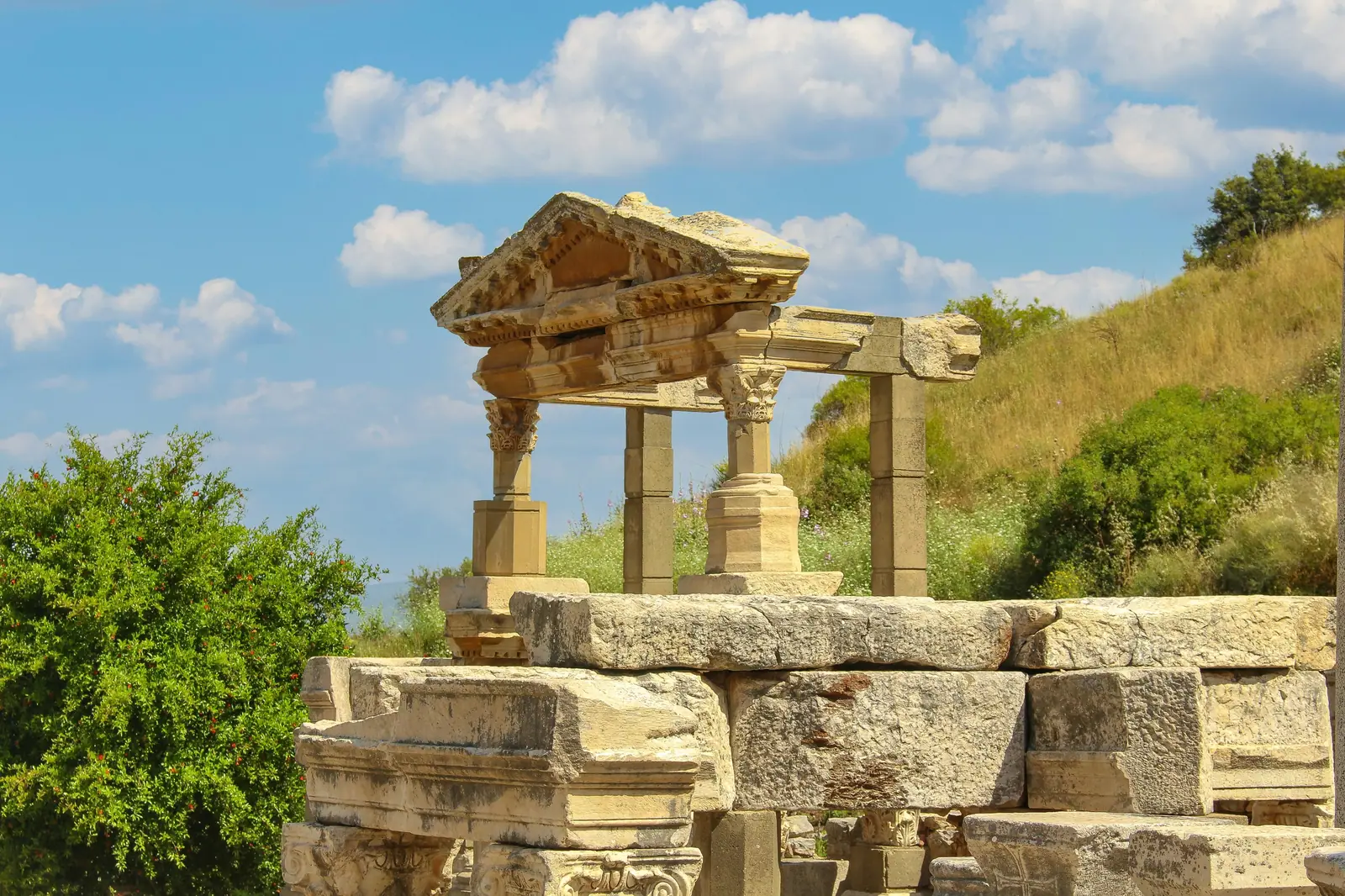
A grand public fountain from the early second century AD, built between AD 102 and 114. Its inscription says it was given by a wealthy citizen, Tiberius Claudius Aristion, and his wife, Julia Lydia Laterane, in honor of Artemis of Ephesus and the emperor Trajan, which is where its modern name comes from. It stood at the end of an aqueduct about 39 kilometers long.
The basin was framed on three sides by a facade about 9.5 meters high, with statues between the columns. A statue of Trajan stood in the central niche, and the water poured into the basin from beneath it, at the emperor's feet. What you see today is a partial rebuild: archaeologists uncovered the fountain in 1957 and set up a section of its columns and pediment in 1962, enough to picture the full two-story front.
Who built the Temple of Hadrian, and was it really Hadrian's?
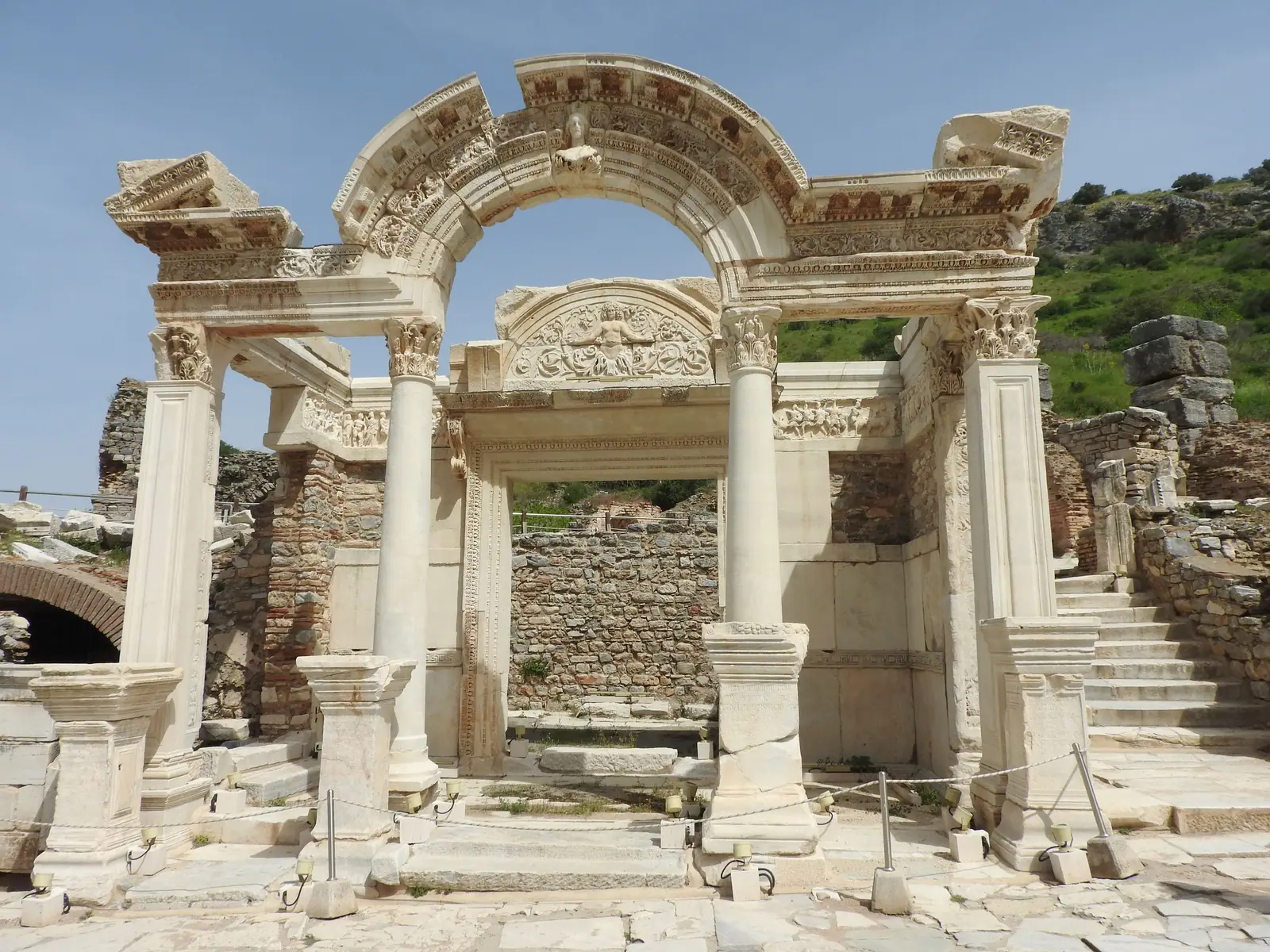
A rich Ephesian named Publius Quintilius Valens Varius paid for it, together with his wife and his daughter Varilla. Its inscription dedicates it to Artemis of Ephesus, to the emperor Hadrian and to the people of Ephesus, and most scholars date it to about AD 117 or 118, early in Hadrian's reign. It was never a temple built by the emperor himself, which is why archaeologists often call it the so-called Temple of Hadrian.
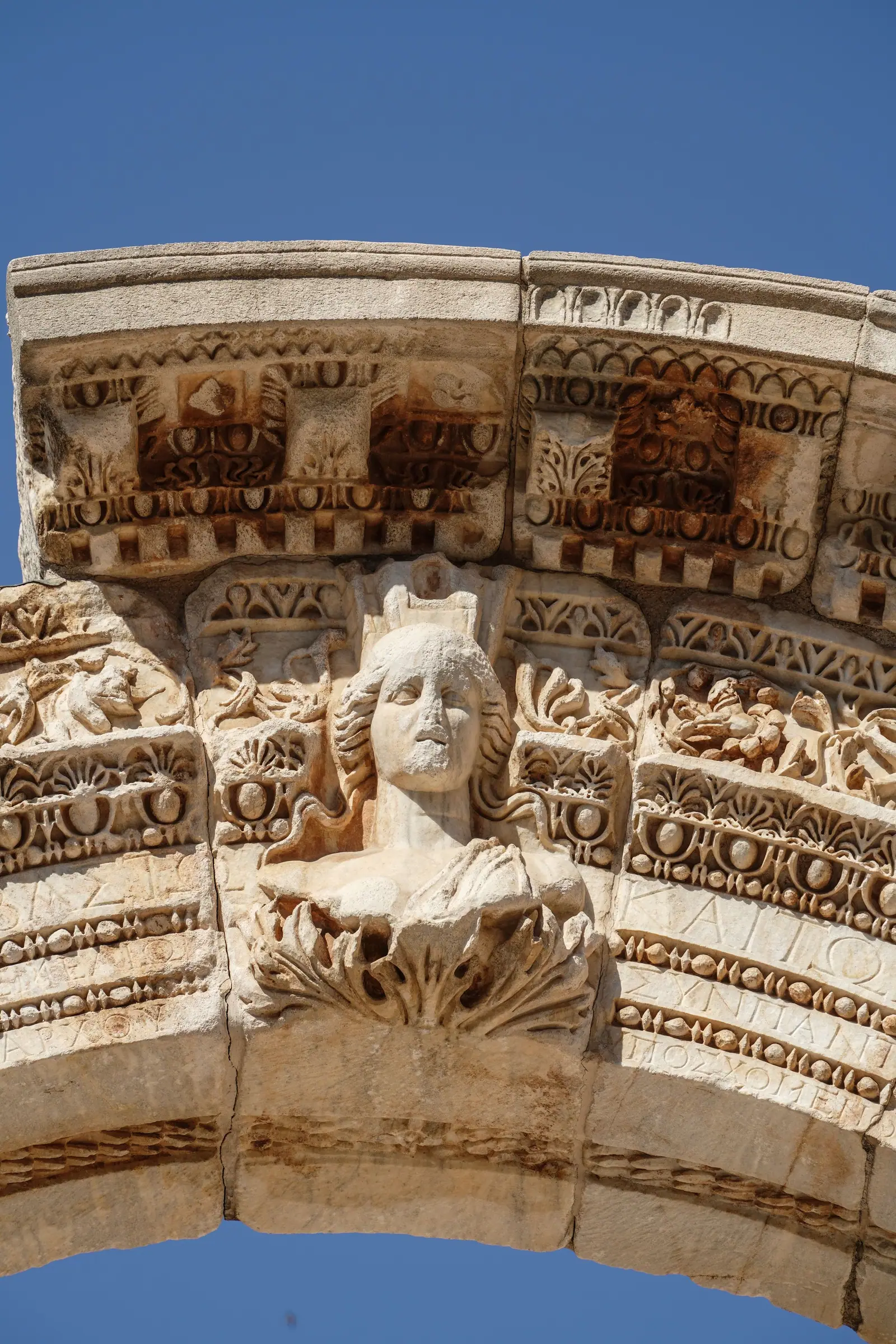
It is small, but it is the most photographed facade on the street. Two columns and two pillars hold up an arch, and in the keystone at its center is a bust of Tyche, the goddess of the city's good fortune. Over the inner doorway a female figure rises out of curling acanthus leaves; many guides call her Medusa. Inside the porch runs a carved frieze showing the founding legend of Ephesus, with Androklos, the city's mythical founder, hunting a wild boar, among gods and Amazons. Figures of the emperor Theodosius I and his family appear in the reliefs too. The frieze you see on site is a cast; the originals are in the Ephesus Museum in Selcuk.
The temple was damaged in the fourth century and repaired, and in front of it stand four inscribed bases that once carried statues of the emperors of that later age. Austrian archaeologists excavated it in the 1950s and partly rebuilt it in 1957 and 1958.
What are the Baths of Scholastica and the latrines?
The baths stand right behind the Temple of Hadrian and were built by the same man, Varius, in the first half of the second century. They were one of the largest bath buildings in Ephesus and once rose three stories; only the ground floor survives. You can still trace the rooms of a Roman bath: a changing hall, a cold room with its pool, a warm room and a hot room, with the brick pillars that carried hot air under the floor.
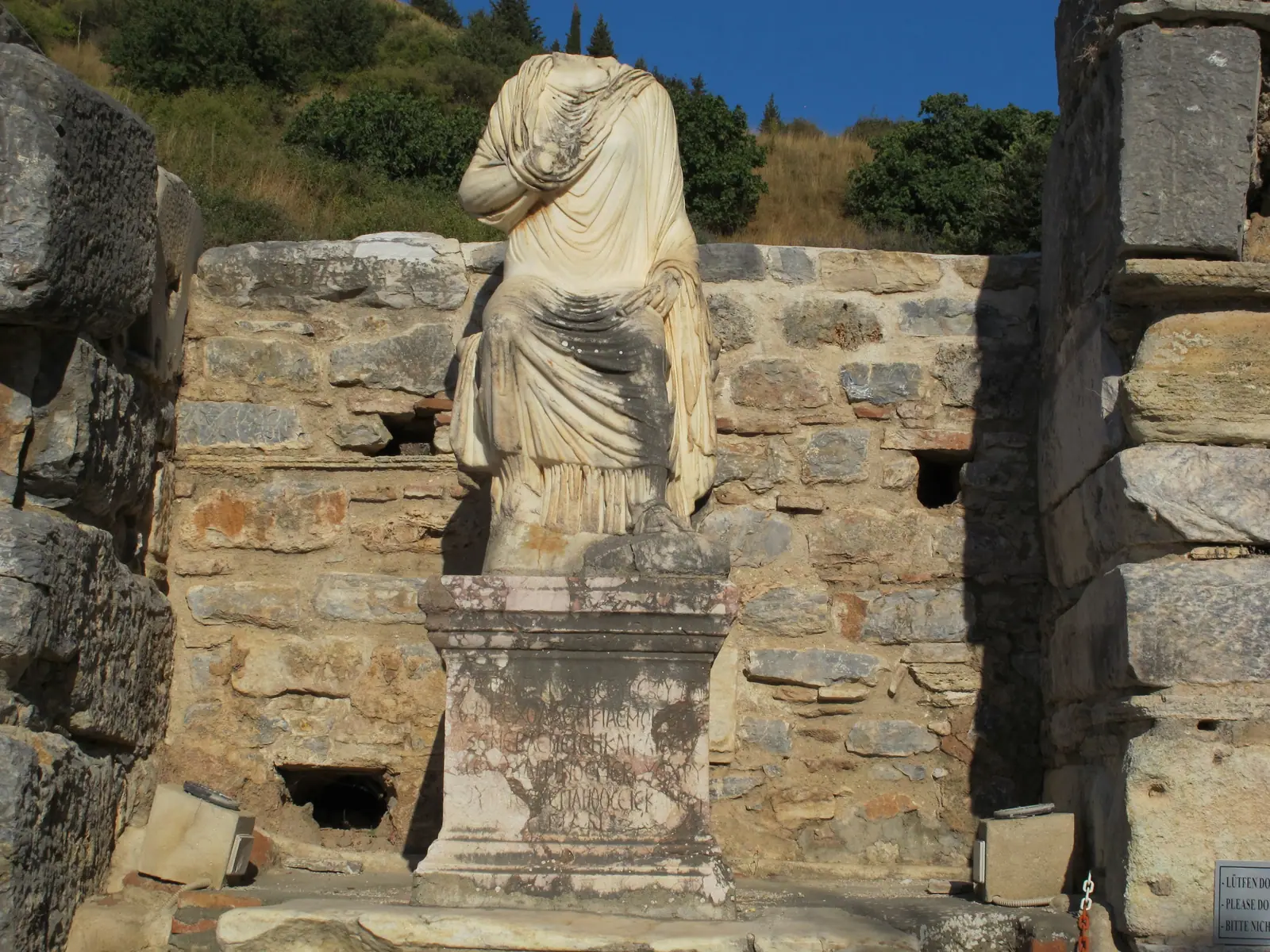
They are named after Scholastica, a wealthy Christian woman of Ephesus who paid to renovate them in the fourth century. Her headless statue still stands in a niche near the side entrance.
From the changing hall, a lane led to the public latrine, and this is the stop guests talk about afterward. Marble seats run around the walls of the room, set over a channel of running water, with a gutter of clean water in front of them and a small pool with four columns in the middle. Sitting here was a social affair in Roman Ephesus, and the marble has held up remarkably well.
What else stands on the lower part of the street?
Partway down, on the slope opposite the Temple of Hadrian, a separate booth marks the entrance to the Terrace Houses, the homes of wealthy Roman families, now under a protective roof. They need their own ticket, and the visit inside takes about 30 to 45 minutes; the route is stairs and steel walkways, so it is not wheelchair accessible.
Near the lower end of the street stands the Octagon, an eight-sided tomb. In its burial chamber archaeologists found the bones of a young woman of high rank, and one Austrian scholar has suggested she was Arsinoe IV, a sister of Cleopatra. It is an intriguing idea, but it has not been proven. Beside it are the remains of a monument to Androklos, the founder you met on the temple frieze.
The last landmark before the library is the Gate of Hadrian, a gateway at the bottom of the street. Then the street opens into the small square in front of the Library of Celsus, and the view everyone came for.
How long do you spend on Curetes Street on a port day?
Longer than anywhere else on the walk, apart from the library and the theater. A guided walk from the Upper Gate to the Lower Gate takes about 1.5 to 2 hours with stops, and tours usually move briskly through the State Agora so they can slow down at Domitian Square and on Curetes Street. Add about 30 to 45 minutes if you take the Terrace Houses.
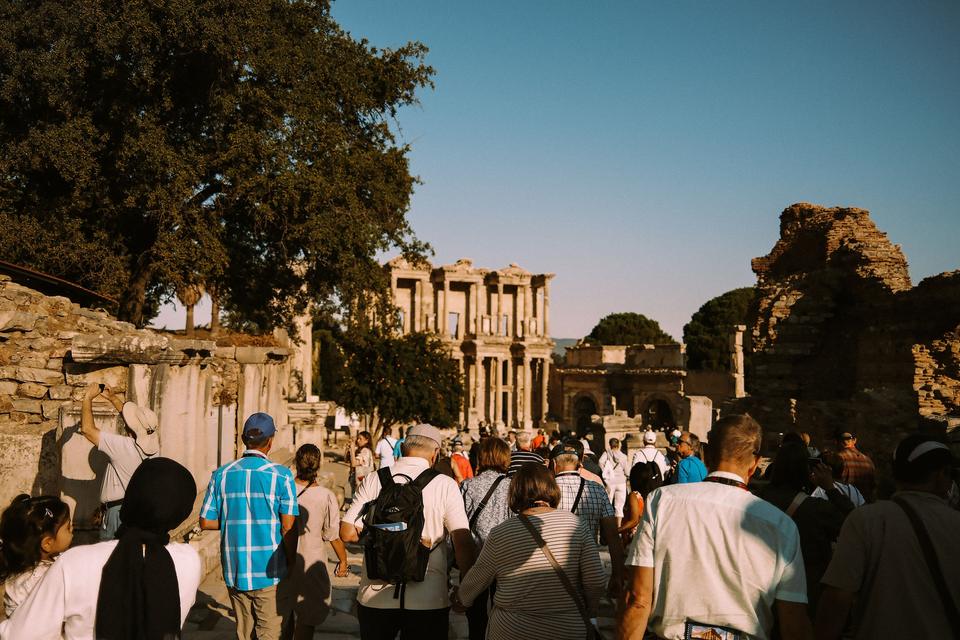
On busy mornings, when several ships are in port, this street and the library fill first, because almost every tour funnels down it in the same direction; our page on crowds on busy port days explains how we time the visit around that. There is almost no shade on the open marble, so bring water and a hat in the warmer months. The slope is gentle but the paving is uneven and polished smooth in places, so wear shoes with some grip.
The accessible route enters and leaves Ephesus by the Lower Gate and stays in the flat lower city, so it does not climb Curetes Street; our wheelchair access page explains what it includes. Our Just Ephesus tour walks the whole street from top to bottom, and if you want more time at the temple, the baths or the Terrace Houses, tell us through our inquiry form and we will plan the pace around your ship's hours.
Questions cruise guests ask us
Is Curetes Street included in the Ephesus ticket?
Yes. The street, the Fountain of Trajan, the Temple of Hadrian, the Baths of Scholastica and the latrines are all inside Ephesus Ancient City, so the standard Ephesus ticket covers them. Only the Terrace Houses need a separate ticket. Entrance tickets are not part of our tour price: we buy skip-the-line tickets in advance and you pay the official price. Our fees page lists the current amounts.
Where does Curetes Street start and end?
It starts at the Hercules Gate, at the lower edge of Domitian Square in the upper city, and ends at the Library of Celsus in the lower city. If you enter at the Upper Gate, you walk it downhill.
Why does Curetes Street run at an angle to the other streets?
Archaeologists think it is older than the right-angled street grid of Roman Ephesus and that religious processions followed its line, so the city kept the old route rather than straightening it.
Is the Temple of Hadrian a real temple?
Yes, a small one. A wealthy citizen, Publius Quintilius Valens Varius, built it around AD 117 or 118 and dedicated it to Artemis, the emperor Hadrian and the people of Ephesus. Hadrian did not build it himself, so archaeologists often call it the so-called Temple of Hadrian.
Can you walk Curetes Street in a wheelchair?
Not as part of the accessible route. That route enters and leaves by the Lower Gate and stays in the flat lower city. Curetes Street is a long slope with uneven, polished paving, and the Terrace Houses beside it have only stairs and steel walkways.
Read next


The sites
Tell us your ship. We will plan the day around it.
Send your ship name, date and all-aboard time, and we reply with a plan and an exact price within 24 hours.
Get My QuoteNo prepayment · Reply within 24 hours · TÜRSAB 15746
Prefer email? info@infoephesus.com
