The sites Ephesus's most photographed facade
The Library of Celsus, Up Close
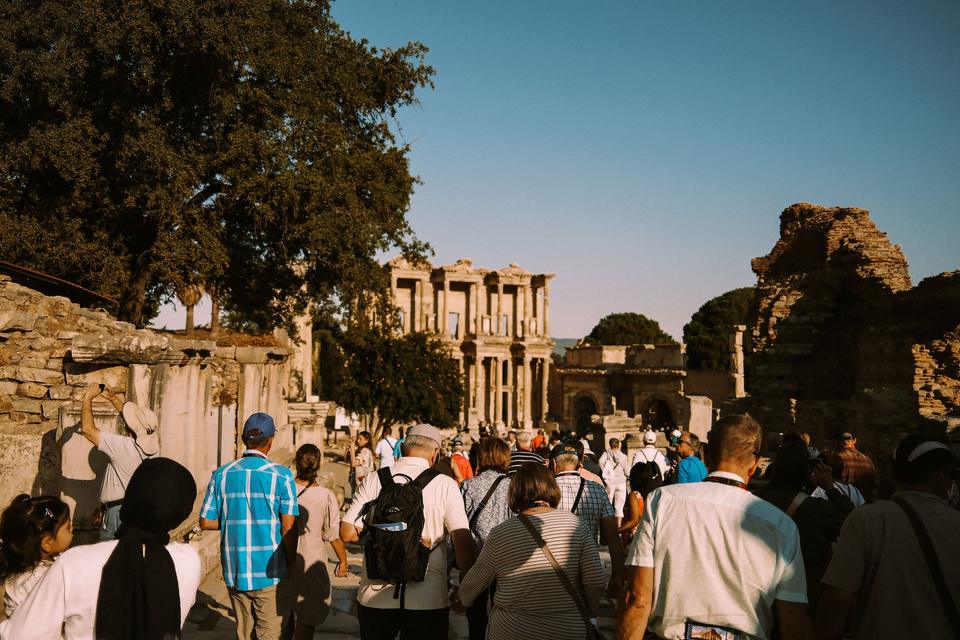
The building everyone photographs at Ephesus was never only a library. It was also a memorial and a burial vault, built by a son for his father, and the four statues standing in its niches today are copies of the ones now in Vienna.
The short answer
The Library of Celsus stands at the bottom of Curetes Street, built in the early second century AD by Tiberius Julius Aquila as a memorial to his father Celsus, a Roman senator who is buried in a vault beneath the floor. Archaeologists rebuilt its two-story marble facade piece by piece in the 1970s. The four virtue statues in its niches are copies; the originals were taken to a museum in Vienna.

- Built by
- Tiberius Julius Aquila, for his father Celsus
- Date
- early second century AD
- Where Celsus is buried
- a vault beneath the library floor
- Facade rebuild
- 1970s, by archaeologists
- Original statues today
- a museum in Vienna; copies stand on site
The Library of Celsus is really a tomb
The building most people photograph at Ephesus was not built as a library first. It was raised as a memorial to a man named Celsus, and he is buried in a vault beneath its floor. Burial inside a city's walls was normally forbidden in the Roman world, so the honor of a tomb at the foot of the city's main street tells you how important Celsus was in his own lifetime.
The library function came with it: shelves for scrolls lined the walls of the reading room above the tomb, but the building's real purpose was to be seen. It still is, more than any other structure at Ephesus.

Who built it, and why
Celsus was a Roman senator who had served as governor of the province of Asia, the region that included Ephesus. After his death, his son, Tiberius Julius Aquila, paid to build the library in his honor, on the site of his father's grave.
The construction dates to the early second century AD, in the decades after Celsus held his post. A son building a tomb this grand for a father was a public statement about the family's standing in the city, not a private gesture.

Planning the day? Match a tour to your hours ashore
-
Time in port: Under 5 hours ashore
The Open-Air Circle
No tickets and almost no walking: Artemis, Selcuk and a drive past the ruins.
Tour length: 3-4 hours
-
Time in port: 5 to 8 hours
Just Ephesus
Ephesus from the Upper Gate down to the Lower Gate, and back with time to spare.
Tour length: 3-3.5 hours
-
Time in port: 8 to 9 hours
Marble, Mosaics and Artemis
All of Ephesus, the Terrace Houses and the Temple of Artemis.
Tour length: 5.5-6.5 hours
-
Time in port: 9 hours or more
The Road of Paul and John
Ephesus, the House of the Virgin Mary, St. John and Artemis.
Tour length: 6-7 hours
-
Time in port: Late arrival, tender or tight call
All-Aboard Ephesus
We plan backward from all-aboard and fit in only what fits.
Tour length: Fits your call
-
Time in port: You have your own list
Your Ship, Your Day
Tell us your ship and your wishes; we build the day around both.
Tour length: Fits your call
Every tour is private and priced from €33 per person for groups of 8 or more; smaller groups get a private quote. Any group size: 1 to 52 people per coach, and more coaches for larger groups. Entrance tickets are extra, at the official price.
The four statues in the facade are copies
Four statues stand in niches across the facade's two stories, representing wisdom, virtue, intellect and knowledge. They are copies. The originals were taken to Vienna during Austrian excavation work at Ephesus and are on display there today, in a museum built specifically to hold finds from the site.
Guides are often asked why Ephesus does not have its own originals back. There is no simple answer on site for that; what stands in the niches now lets visitors see the composition the sculptors intended, even without the originals themselves.

A two-story facade rebuilt piece by piece
What you see today is largely a reconstruction. The facade had collapsed over the centuries, and in the 1970s archaeologists pieced its columns, cornices and niches back together using the original stones wherever they survived, a technique known as anastylosis.
The result is one of the most complete Roman facades anywhere in the Mediterranean, built almost entirely from its own fallen pieces rather than new material. That is part of why it photographs so well: the marble carries its real age.

Where it sits on the walk through Ephesus
The library marks the point where Curetes Street ends and the Commercial Agora begins, right beside the Mazeus-Mithridates Gate. It is the natural stop between the temples and fountains above it and the Great Theater below. Our full walk through Ephesus sets it in that wider order.
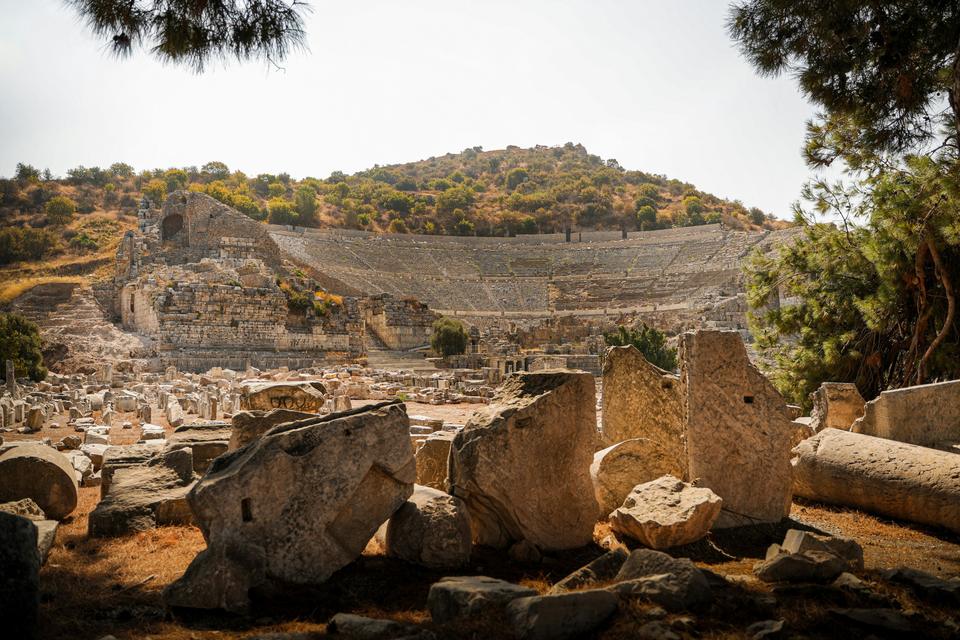
From the library, Marble Street leads on toward the Great Theater, the other structure most guests remember afterward.

The best time of day to see it
The facade faces the morning sun, so guides who can set their own schedule aim to reach it before mid-morning, while the light is still on the columns and before the crowd in front of it builds. Multi-ship mornings fill this stretch of Curetes Street fastest, since every tour, ship-run or private, ends up here.
A private day lets you time that stop around your own ship's call rather than a fixed excursion group; our custom shore excursion can put the library early in the walk if photographs matter to you. Ask us through our inquiry form and we will plan around it.

Questions cruise guests ask us
Is the Library of Celsus really a library?
Only in part. It held scrolls in a reading room, but it was built above all as a memorial and burial vault for Celsus, a Roman senator whose son paid for the building. The library function came second to that purpose.
Why are the statues at the Library of Celsus copies?
The originals were removed to Vienna during Austrian excavation work at Ephesus and remain in a museum there. The four figures now in the niches are copies, standing in for statues representing wisdom, virtue, intellect and knowledge.
Who is buried under the Library of Celsus?
Celsus himself, a former governor of the province of Asia, in a vault beneath the reading room. His son, Tiberius Julius Aquila, built the library above the grave as a public memorial to him.
When was the Library of Celsus rebuilt?
Its collapsed facade was pieced back together in the 1970s, using the original fallen stones wherever they survived. What stands today is mostly ancient marble, reassembled rather than replaced.
What is the best time to photograph the Library of Celsus?
Morning, while the sun still lights the facade directly and before the crowd in front of it builds. A private tour can put this stop earlier in the day than a fixed excursion group usually manages.
Read next

Tell us your ship. We will plan the day around it.
Send your ship name, date and all-aboard time, and we reply with a plan and an exact price within 24 hours.
Get My QuoteNo prepayment · Reply within 24 hours · TÜRSAB 15746
Prefer email? info@infoephesus.com
