The sites The site's largest stage
The Great Theater: Tiers of Seats and One Famous Riot
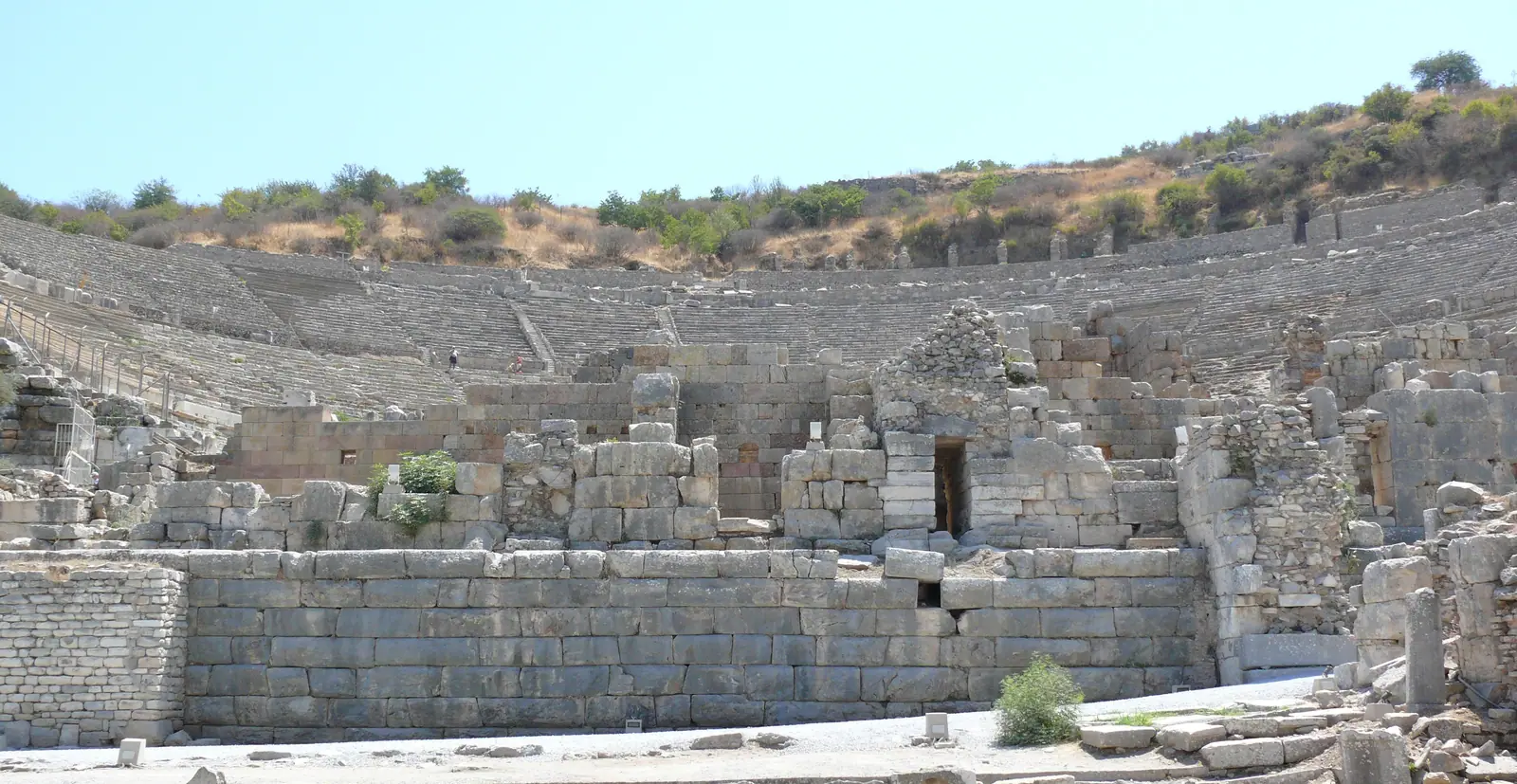
Cut into the hillside where Marble Street meets Harbor Street, the Great Theater is the largest structure at Ephesus and the setting for a riot the book of Acts describes in detail.
The short answer
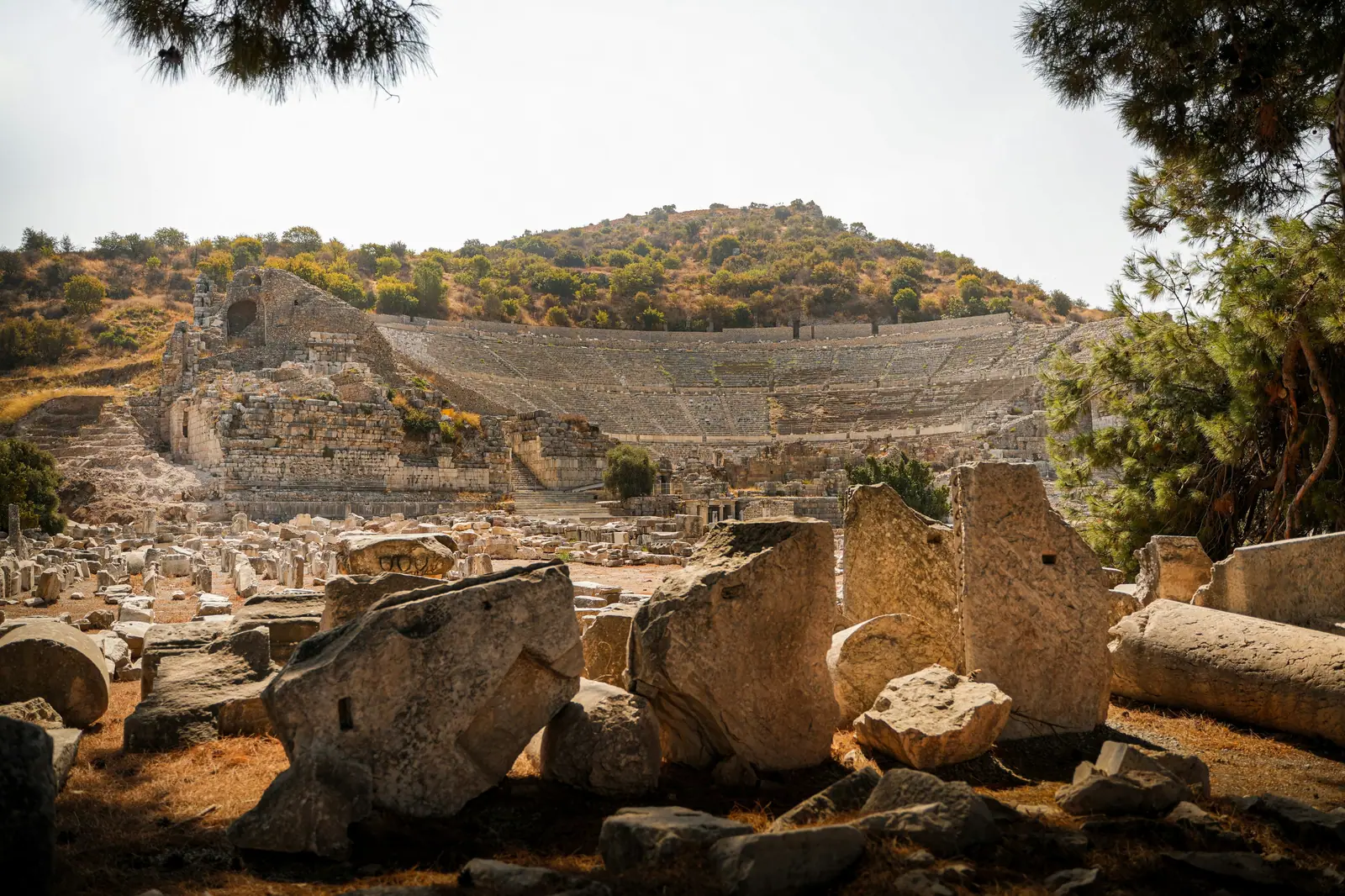
The Great Theater of Ephesus is cut into the slope of Mount Pion and seated about 24,000-25,000 people, by the commonly cited estimate, making it the largest structure on the site. The book of Acts places a riot here, stirred up by a silversmith named Demetrius, in which two of Paul's traveling companions were dragged in while Paul himself was held back. From the top tiers, the view runs straight down the old theater's axis toward Harbor Street.
- Capacity
- about 24,000-25,000, by the commonly cited estimate
- Built into
- the slope of Mount Pion (Panayir Dagi)
- Biblical event
- the riot in Acts 19, stirred up by Demetrius the silversmith
- Sits between
- Marble Street above, Harbor Street below
The Great Theater and the size of its crowd
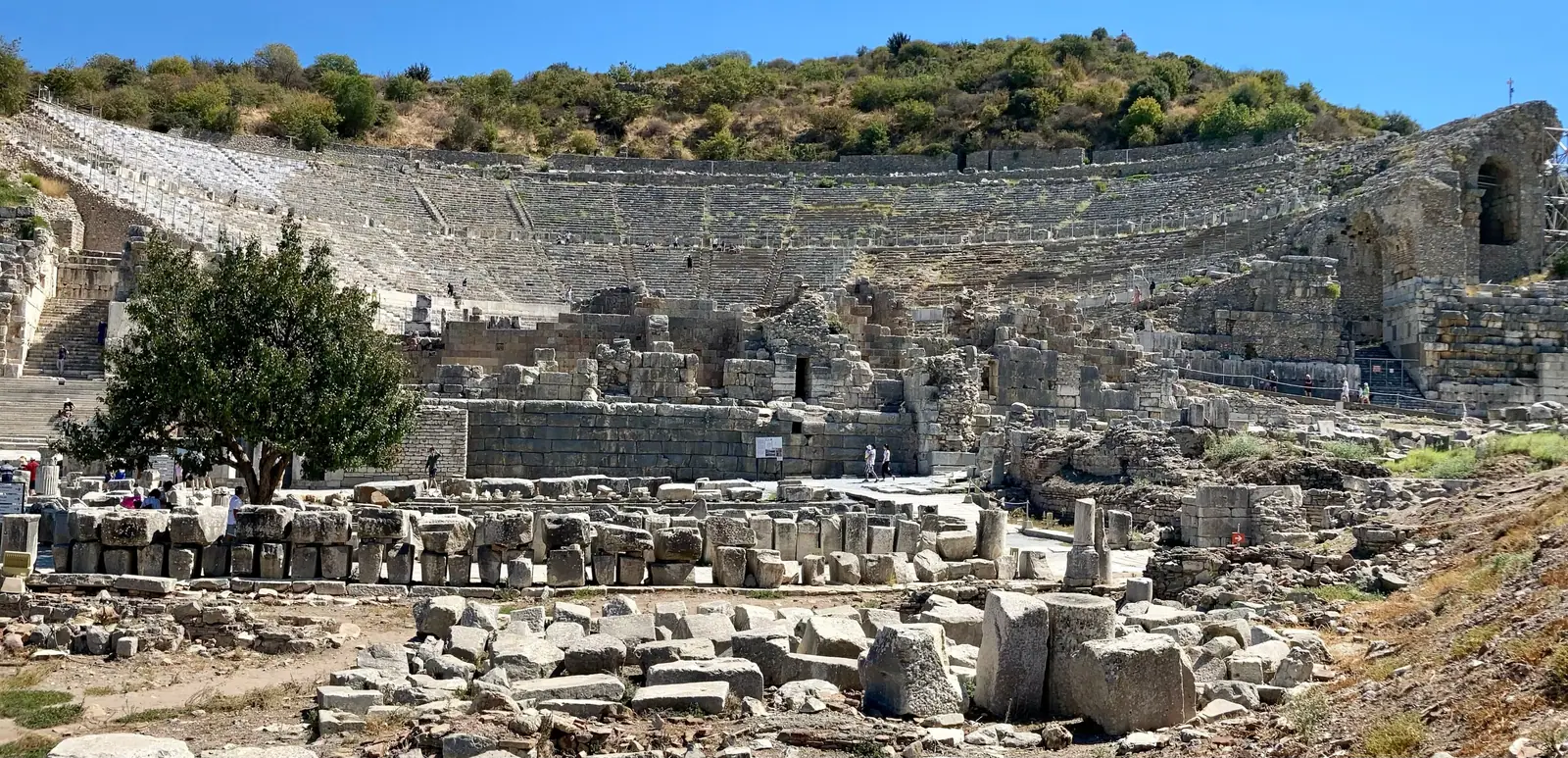
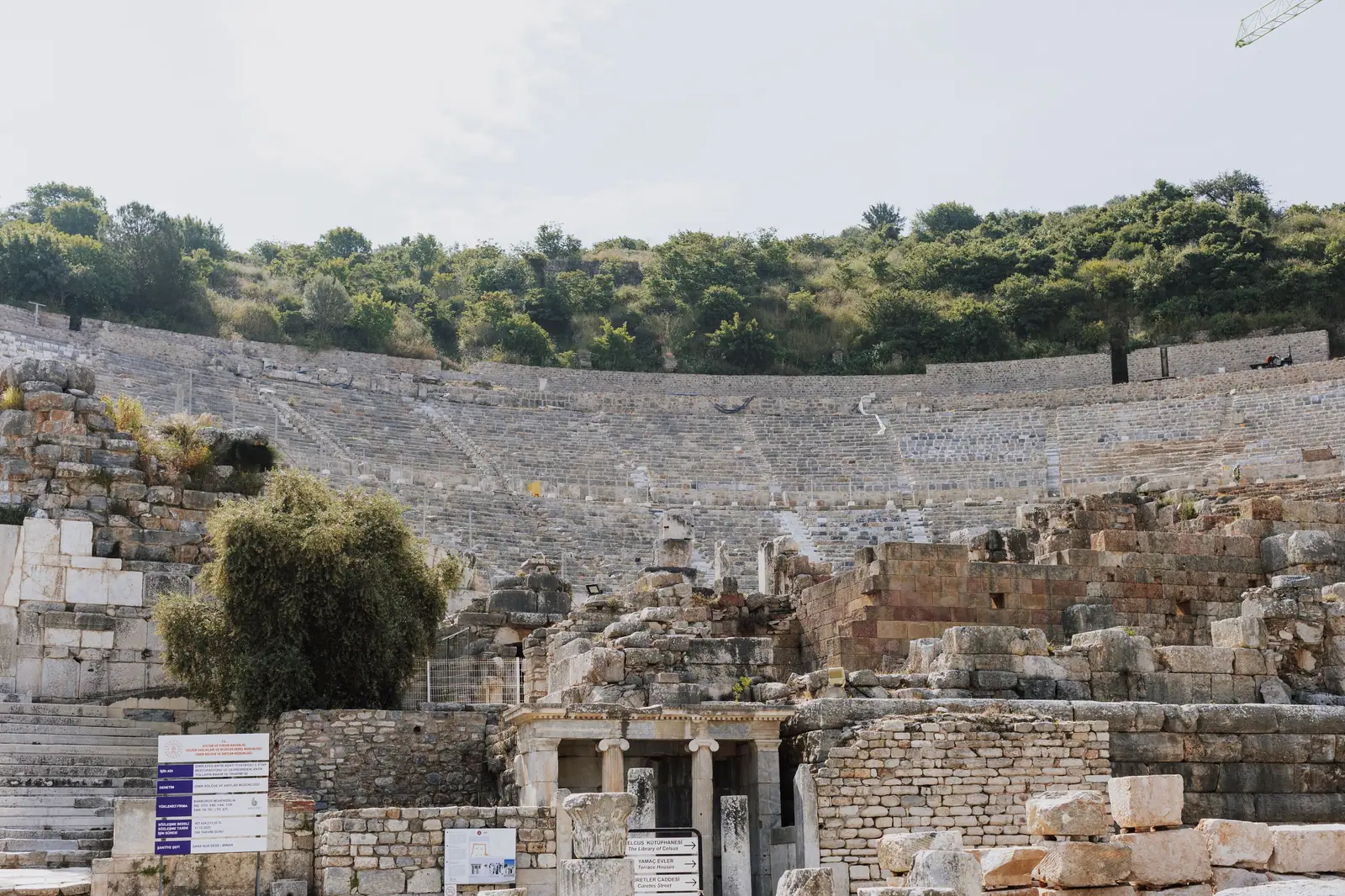
The Great Theater is cut directly into the hillside of Mount Pion, using the slope itself as the rising bank of seats rather than building one from scratch. It began as a smaller Hellenistic theater and was enlarged under later Roman emperors into the structure whose tiers you climb today.
Its capacity is usually put at about 24,000 to 25,000 people, the commonly cited estimate for the site, which makes it the largest single structure at Ephesus by a wide margin. Nothing else on the walk approaches its scale.
The riot Acts 19 describes inside these walls
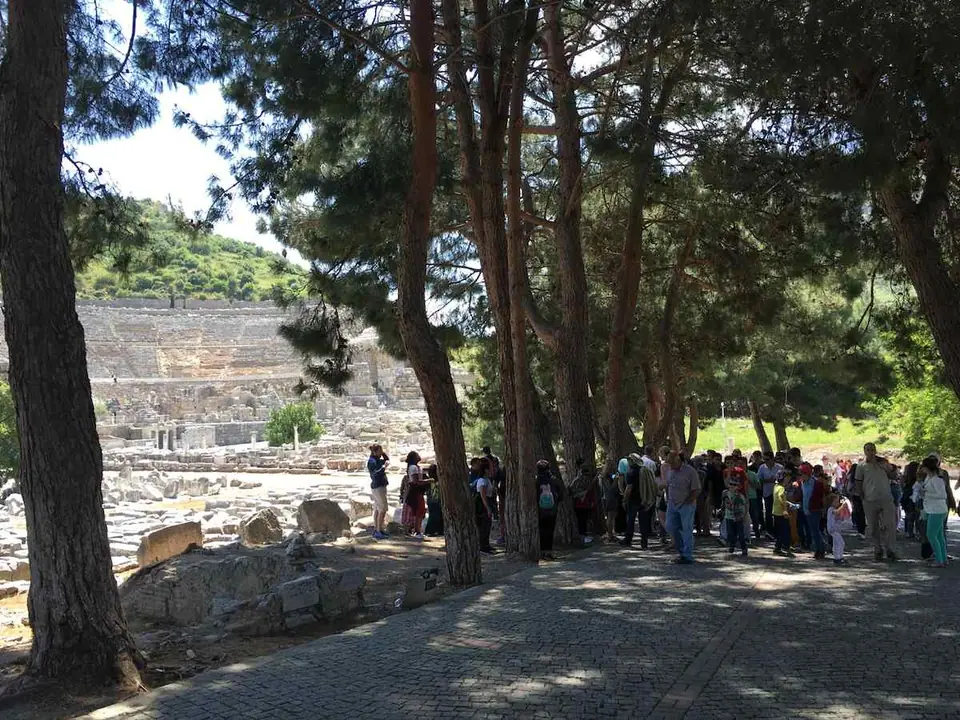
The New Testament book of Acts sets a riot inside this theater. Paul had been preaching in Ephesus long enough to hurt the trade of Demetrius, a silversmith who made silver shrines of the goddess Artemis, and Demetrius stirred up a crowd that filled the theater shouting in her defense.
According to the account, it was two of Paul's traveling companions who were dragged into the theater, not Paul himself: the disciples and some of the city's officials held him back before he could follow them in. A city official eventually calmed the crowd and sent it home.
Planning the day? Match a tour to your hours ashore
-
Time in port: Under 5 hours ashore
The Open-Air Circle
No tickets and almost no walking: Artemis, Selcuk and a drive past the ruins.
Tour length: 3-4 hours
-
Time in port: 5 to 8 hours
Just Ephesus
Ephesus from the Upper Gate down to the Lower Gate, and back with time to spare.
Tour length: 3-3.5 hours
-
Time in port: 8 to 9 hours
Marble, Mosaics and Artemis
All of Ephesus, the Terrace Houses and the Temple of Artemis.
Tour length: 5.5-6.5 hours
-
Time in port: 9 hours or more
The Road of Paul and John
Ephesus, the House of the Virgin Mary, St. John and Artemis.
Tour length: 6-7 hours
-
Time in port: Late arrival, tender or tight call
All-Aboard Ephesus
We plan backward from all-aboard and fit in only what fits.
Tour length: Fits your call
-
Time in port: You have your own list
Your Ship, Your Day
Tell us your ship and your wishes; we build the day around both.
Tour length: Fits your call
Every tour is private and priced from €33 per person for groups of 8 or more; smaller groups get a private quote. Any group size: 1 to 52 people per coach, and more coaches for larger groups. Entrance tickets are extra, at the official price.
Testing the acoustics for yourself
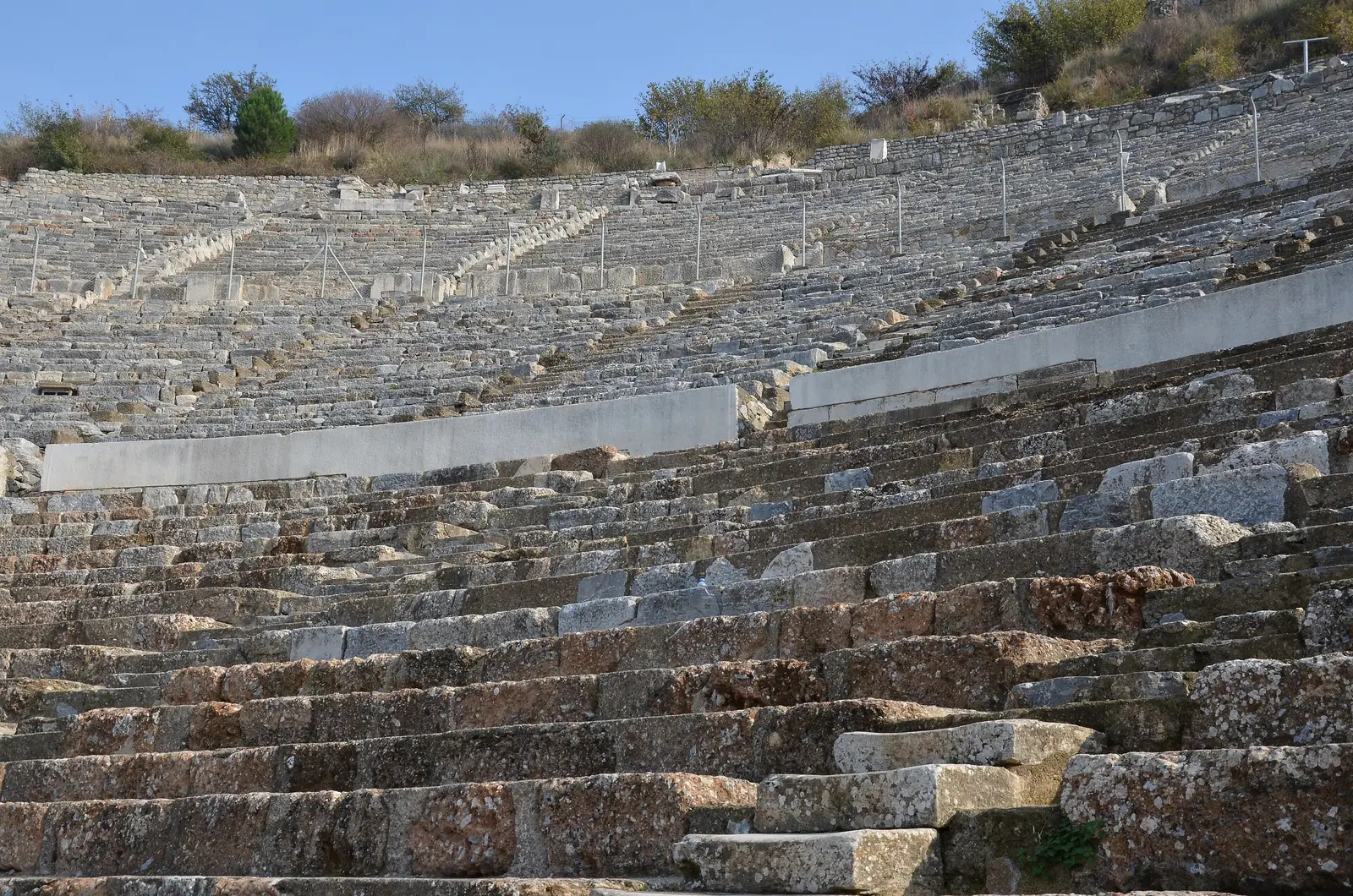
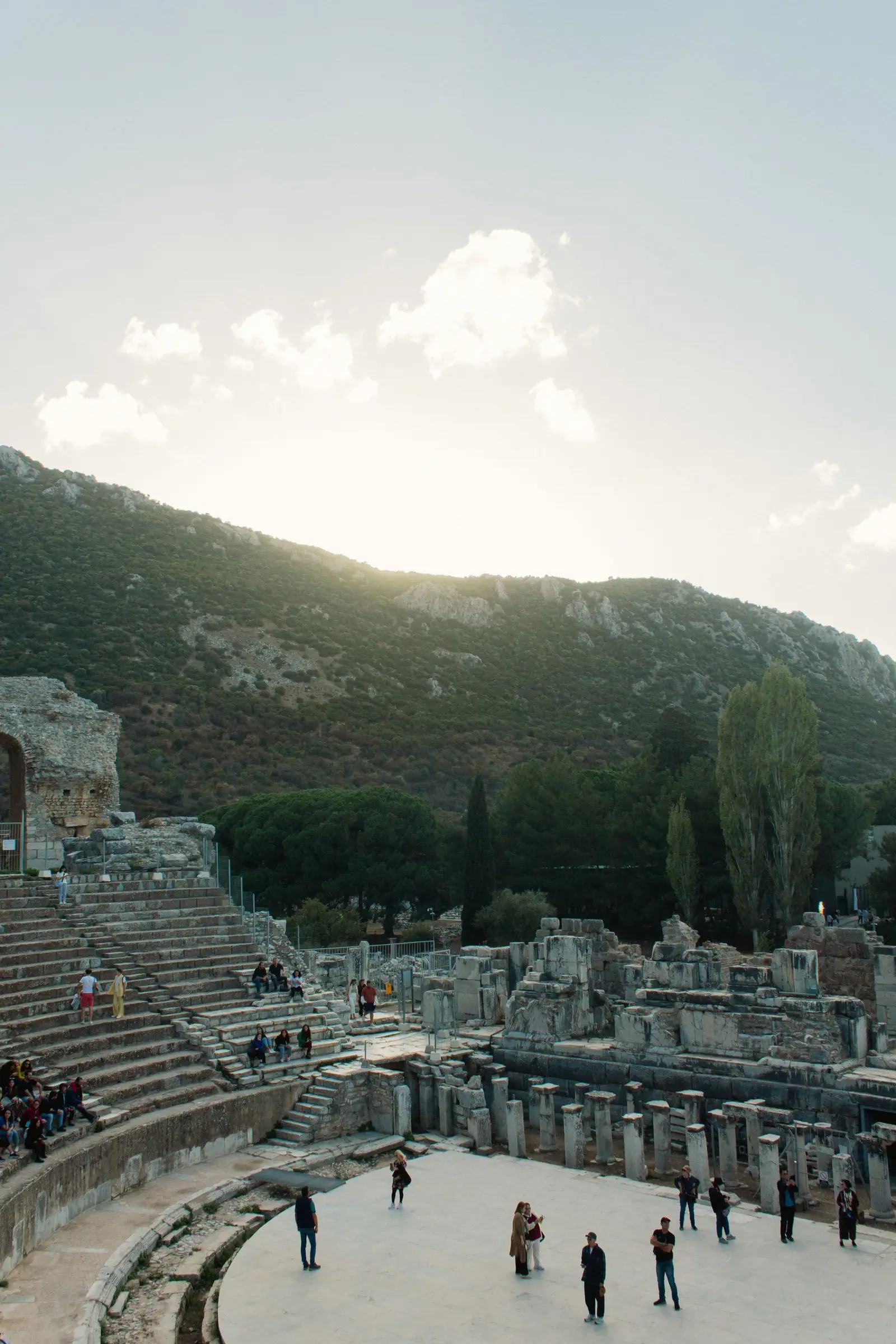
Visitors standing in the orchestra, the flat space at the base of the seating, often test how far a normal speaking voice carries up the tiers, and the curved stone rows do genuinely carry sound further than you would expect without any amplification. It is one of the more common small experiments people run on their own at this stop.
The effect fades toward the highest rows, which sat furthest from the stage even in Roman times, but a clear voice from the orchestra still reaches surprisingly far up the slope.
The view down Harbor Street
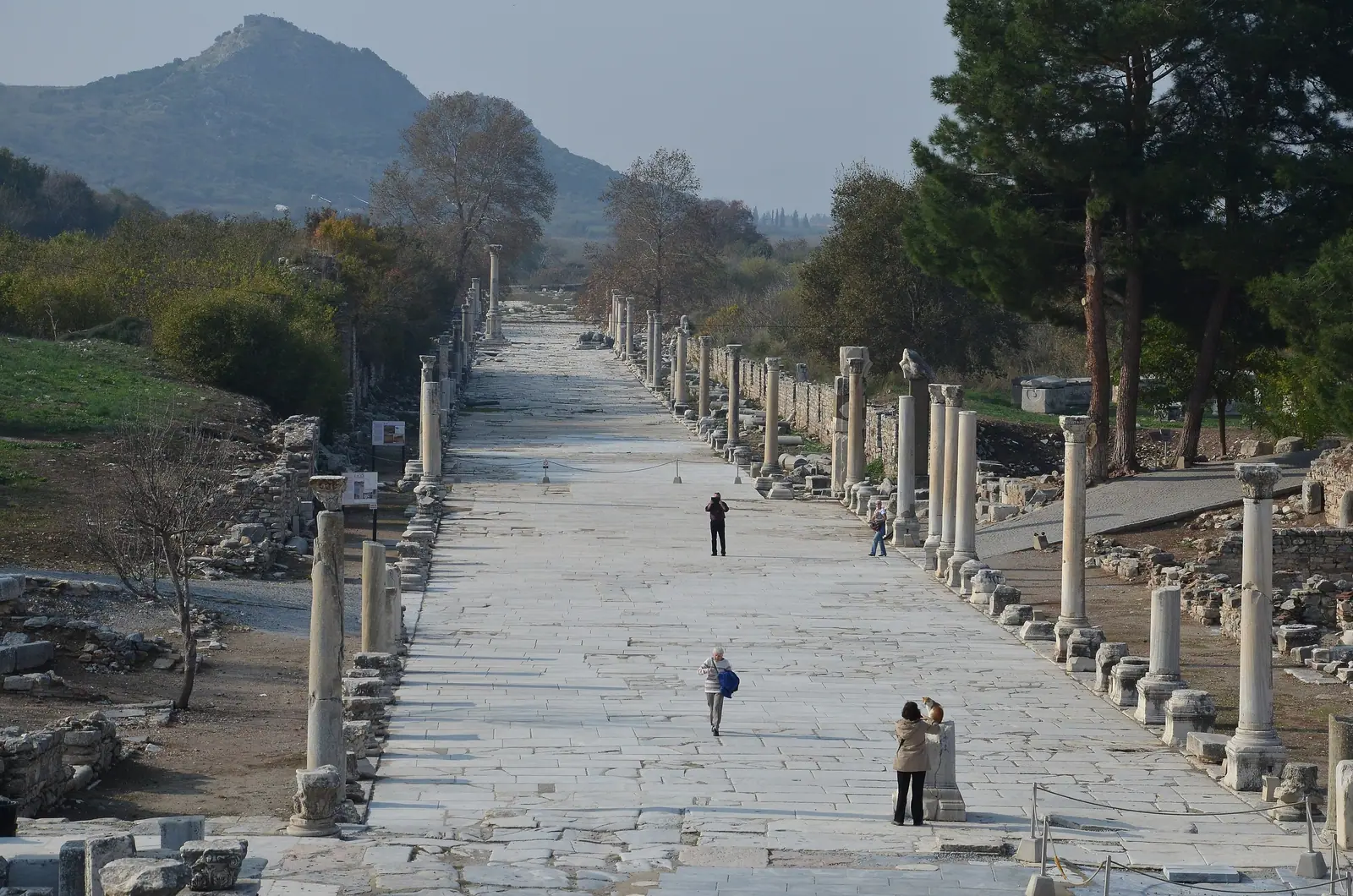
From the upper tiers, the theater's central axis lines up with Harbor Street below, the colonnaded road that once ran straight to Ephesus's port. Centuries of silt moved the coastline well away from the city, so the view today runs toward open ground rather than water, but the straight line of the old street is still easy to pick out from up high.
It is one of the better places on site to see how the ancient city was laid out as a whole, rather than street by street.
Where the theater sits on the walk through Ephesus
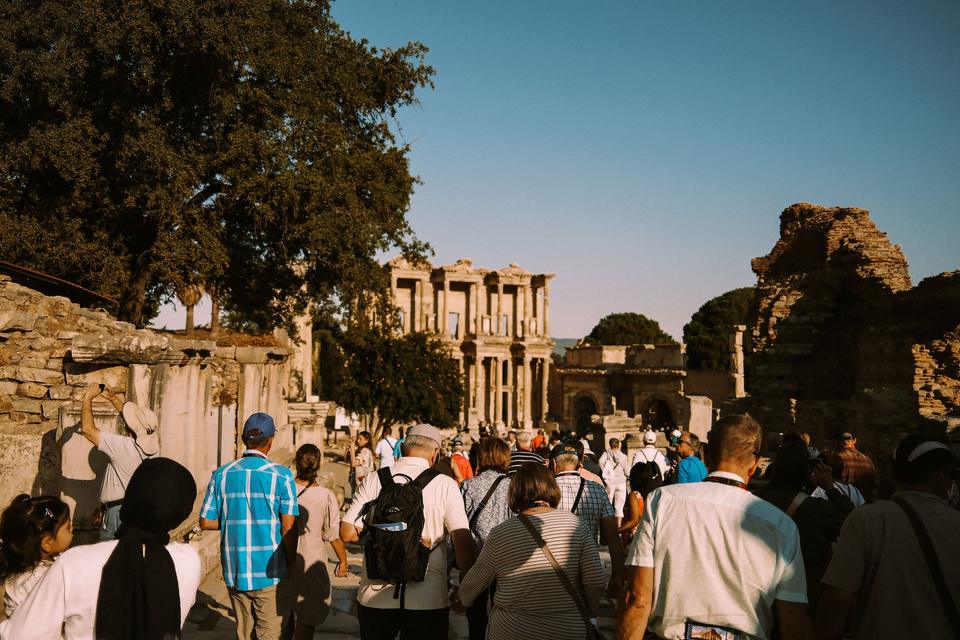
The theater sits at the bottom of Marble Street, just past the Library of Celsus and the Commercial Agora, marking the last major stop before Harbor Street and the Lower Gate. Our full walk through Ephesus sets it in that wider order, and the Library of Celsus page covers the stop just before it.
Most tours reach the theater later in the walk, once legs are tired from the downhill stretch, so pacing this stop with a rest on the seats themselves is worth doing.
What a guide can add here that a sign cannot
The information panels on site give the theater's size and its biblical connection in a few lines. A guide can walk you to the exact spot in the orchestra where the acoustics work best, place the Acts 19 story against the temples and workshops you have just walked past, and time your visit for a quieter half hour between excursion groups.
Our Road of Paul and John tour spends real time at this stop for exactly that reason. Tell us your ship's call length through our inquiry form and we will build the day around it.
Questions cruise guests ask us
How big is the Great Theater at Ephesus?
About 24,000 to 25,000 people, by the commonly cited estimate, cut into the slope of Mount Pion. It is the largest single structure at Ephesus, and nothing else on the site comes close to its scale.
What happened in Ephesus's theater in the Bible?
A riot did, according to the book of Acts. A silversmith named Demetrius, whose trade in silver shrines of Artemis was hurt by Paul's preaching, stirred up a crowd that filled the theater before a city official calmed it down.
Was Paul dragged into the theater?
No. According to Acts 19, it was two of his traveling companions who were dragged in. The disciples and some city officials held Paul back before he could follow them, and he never entered the theater during the riot.
Can you still hear well from the top row of the Great Theater?
A clear voice from the orchestra at the base carries noticeably far up the curved stone rows, though the effect fades toward the highest seats. Many visitors test it themselves by speaking or clapping from the center.
What is at the bottom of the Great Theater?
Harbor Street, the colonnaded road that once ran straight to Ephesus's ancient port before the coastline moved inland. The theater's central axis still lines up with that old street when you look down from the top tiers.
Read next

The sites
Tell us your ship. We will plan the day around it.
Send your ship name, date and all-aboard time, and we reply with a plan and an exact price within 24 hours.
Get My QuoteNo prepayment · Reply within 24 hours · TÜRSAB 15746
Prefer email? info@infoephesus.com
