The sites What one column marks
The Temple of Artemis: What Is Left of a Wonder
A single reconstructed column and an open field beside the road are what remain of a temple once counted among the Seven Wonders of the Ancient World. Entrance is included in our tours, and there is no gate to pass through.
The short answer
The Temple of Artemis once stood among the Seven Wonders of the Ancient World, and today the site is an open field beside the road into Selçuk, marked by a single column built up from broken fragments. Entrance is included in our tours, and there is no gate; you walk in from the roadside. Most visitors spend about 10 to 15 minutes here, and it pairs naturally with other short stops in Selçuk on the same drive.

- Entrance
- Included in our tours; open ground beside the road
- What stands today
- One reconstructed column, built up from broken fragments
- Time needed
- About 10 to 15 minutes
- Tours that stop here
- The Open-Air Circle, Marble Mosaics and Artemis, and The Road of Paul and John
What is actually left of the Temple of Artemis?
An open, marshy field beside the road into Selçuk, with a single column standing near where the temple once did. That column is not original in the way a whole ancient column would be; it was pieced together from broken drums found on the site, mostly to give visitors something upright to stand next to. Around it, low walls and scattered blocks mark where a vast building once stood, but there is no gate to pass through, and the entrance is included in our tours.

Why was this temple counted among the Seven Wonders?
Ancient writers ranked the Temple of Artemis among the Seven Wonders of the Ancient World for its size: it was said to be one of the largest buildings the Greek world had produced, ringed by rows of tall marble columns. Tradition holds that the temple burned in 356 BC, an act ancient sources blame on a man named Herostratus, and that the Ephesians rebuilt it on an even larger scale afterward. Earthquakes, river silting and centuries of quarrying for other buildings are the reasons so little of either version survives above ground today.

Planning the day? Match a tour to your hours ashore
-
Time in port: Under 5 hours ashore
The Open-Air Circle
No tickets and almost no walking: Artemis, Selcuk and a drive past the ruins.
Tour length: 3-4 hours
-
Time in port: 5 to 8 hours
Just Ephesus
Ephesus from the Upper Gate down to the Lower Gate, and back with time to spare.
Tour length: 3-3.5 hours
-
Time in port: 8 to 9 hours
Marble, Mosaics and Artemis
All of Ephesus, the Terrace Houses and the Temple of Artemis.
Tour length: 5.5-6.5 hours
-
Time in port: 9 hours or more
The Road of Paul and John
Ephesus, the House of the Virgin Mary, St. John and Artemis.
Tour length: 6-7 hours
-
Time in port: Late arrival, tender or tight call
All-Aboard Ephesus
We plan backward from all-aboard and fit in only what fits.
Tour length: Fits your call
-
Time in port: You have your own list
Your Ship, Your Day
Tell us your ship and your wishes; we build the day around both.
Tour length: Fits your call
Every tour is private and priced from €33 per person for groups of 8 or more; smaller groups get a private quote. Any group size: 1 to 52 people per coach, and more coaches for larger groups. Entrance tickets are extra, at the official price.
How does this site connect to Acts 19?
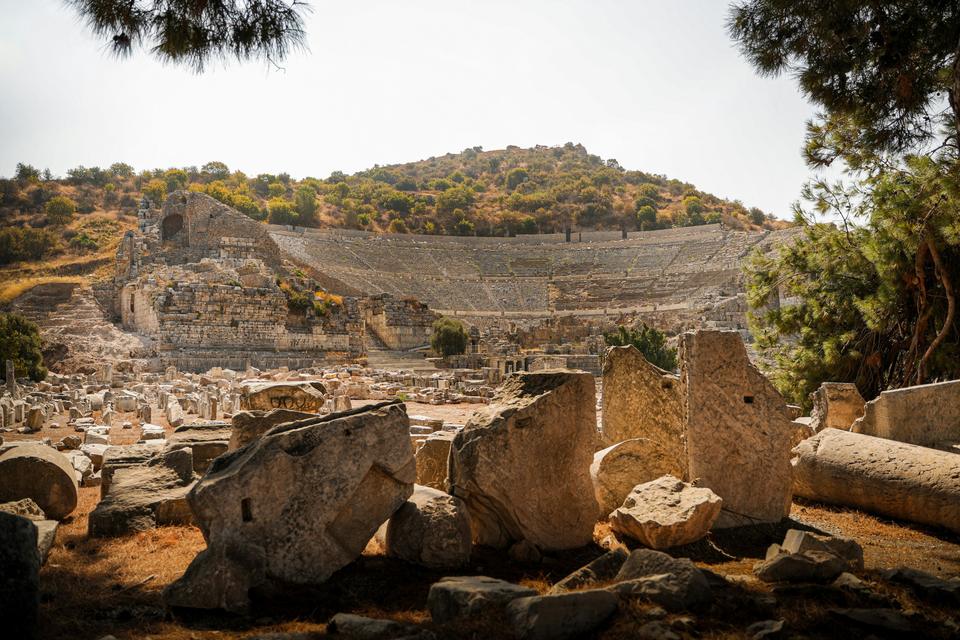
The New Testament book of Acts describes a riot in Ephesus led by a silversmith named Demetrius, whose trade in silver shrines depended on the cult built around this temple. When the crowd's shout of "Great is Artemis of the Ephesians" filled the Great Theater, it was this temple, and the income it brought the city, that the riot was defending. Standing on the open ground where the temple stood is the closest a visitor gets to the physical setting behind that account.

What will you actually see, and is it worth the stop?
Manage your expectations: this is not a ruin on the scale of the Library of Celsus or the Great Theater, and first-time visitors sometimes find the field underwhelming next to the column's outsized history. What makes it worth a short stop is exactly that contrast, between what the ancient world considered a wonder and what time has left of it. It reads best as a quick, thoughtful pause on the way to or from Selçuk, not as a destination on its own.

How much time does it take, and which tour goes there?
Most visitors need about 10 to 15 minutes: there is one column, a field, and a short walk around it, with nothing further to see. It sits close to Selçuk, so it pairs naturally with other quick stops in town. Our Open-Air Circle tour is built around exactly this kind of short stop, with the entrance included, and both Marble, Mosaics and Artemis and The Road of Paul and John add it to a longer day at Ephesus itself. If your call does not fit any of the six as they stand, our inquiry form is the fastest way to build a day around it.

Questions cruise guests ask us
Is the entrance to the Temple of Artemis included in your tours?
Yes. The entrance is included in every tour of ours that stops there. The site is open ground beside the road. You walk in from the roadside and leave whenever you are ready; there is no gate to pass through.
How much of the original temple is still standing?
Almost nothing in its original form. A single column stands on the site today, assembled from broken fragments found nearby, mainly to mark the spot. The rest is an open field with scattered blocks and low walls.
Was the Temple of Artemis really one of the Seven Wonders?
Yes. Ancient writers ranked the Temple of Artemis among the Seven Wonders of the Ancient World for its size and its rows of marble columns. Tradition holds that an earlier temple on the site burned in 356 BC and was rebuilt on a larger scale, before the site's eventual decline.
How does the Temple of Artemis connect to the Bible?
Acts 19 describes a riot in Ephesus led by a silversmith named Demetrius, whose trade in silver shrines depended on the cult centered on this temple. The crowd's shout in the Great Theater was defending the income this temple brought the city.
Which tour visits the Temple of Artemis?
The Open-Air Circle is built around it, with the entrance included, along with other stops in Selçuk. Marble, Mosaics and Artemis and The Road of Paul and John both add it to a fuller day at Ephesus, since it sits close to the road between the site and Selçuk.
Read next


Tell us your ship. We will plan the day around it.
Send your ship name, date and all-aboard time, and we reply with a plan and an exact price within 24 hours.
Get My QuoteNo prepayment · Reply within 24 hours · TÜRSAB 15746
Prefer email? info@infoephesus.com
