The sites A Roman family on show
The Memmius Monument: Sulla's Family in Marble
Just before Curetes Street starts its long run down to the Library of Celsus, a cluster of carved blocks and half-rebuilt piers stands at the edge of Domitian Square. Most people photograph the figures and walk on. Here is who they were.
The short answer
The Memmius Monument is a carved Roman monument of the second half of the first century BC, built for Gaius Memmius, grandson of the dictator Sulla and later governor of the province of Asia. Its partly rebuilt piers and relief figures stand on the north side of Domitian Square, where Curetes Street begins, and the standard Ephesus ticket covers it.

- Built for
- Gaius Memmius, grandson of the dictator Sulla
- Date
- second half of the first century BC
- The inscription
- C MEMMIO C F SULLAE FELICIS N
- What stands today
- rebuilt piers and blocks carved with relief figures
- Where
- north side of Domitian Square, at the top of Curetes Street
- Ticket
- covered by the standard Ephesus Ancient City ticket
What is the Memmius Monument?
It is a Roman family monument, put up in the second half of the first century BC to honor Gaius Memmius, a grandson of the dictator Sulla. It stands on the north side of Domitian Square, at the point where the square narrows into Curetes Street.
In its day it was a tall structure on a stepped base, and it may have risen three stories. Its blocks were carved with figures in high relief. What you see now is a partial rebuild: Austrian archaeologists studied it and published it in 1971, and some of its piers and relief blocks have been set back up on the base. Even guides admit the rebuilt version is hard to read at first glance, which is why most groups give it a quick look and move on.

Who was Gaius Memmius?
A Roman senator with a famous grandfather. His father, also Gaius Memmius, was a politician of the 50s BC, best remembered today as the man to whom the poet Lucretius dedicated On the Nature of Things. His mother, Fausta Cornelia, was the daughter of Lucius Cornelius Sulla, the general who made himself dictator of Rome.
The younger Memmius became a suffect consul in 34 BC and later served as governor of the province of Asia, sometime after 30 BC. Ephesus was the seat of that governor, so the city had every reason to honor him, and the monument was set up during his term. It honored him and three generations of his family, and its inscription spells out the family tie in a single line:
C MEMMIO C F SULLAE FELICIS N: to Gaius Memmius, son of Gaius, grandson of Sulla Felix.
Felix, "the lucky one", was the name Sulla chose for himself. Putting it on a monument in Ephesus said exactly whose grandson had come to govern.

Planning the day? Match a tour to your hours ashore
-
Time in port: Under 5 hours ashore
The Open-Air Circle
No tickets and almost no walking: Artemis, Selcuk and a drive past the ruins.
Tour length: 3-4 hours
-
Time in port: 5 to 8 hours
Just Ephesus
Ephesus from the Upper Gate down to the Lower Gate, and back with time to spare.
Tour length: 3-3.5 hours
-
Time in port: 8 to 9 hours
Marble, Mosaics and Artemis
All of Ephesus, the Terrace Houses and the Temple of Artemis.
Tour length: 5.5-6.5 hours
-
Time in port: 9 hours or more
The Road of Paul and John
Ephesus, the House of the Virgin Mary, St. John and Artemis.
Tour length: 6-7 hours
-
Time in port: Late arrival, tender or tight call
All-Aboard Ephesus
We plan backward from all-aboard and fit in only what fits.
Tour length: Fits your call
-
Time in port: You have your own list
Your Ship, Your Day
Tell us your ship and your wishes; we build the day around both.
Tour length: Fits your call
Every tour is private and priced from €33 per person for groups of 8 or more; smaller groups get a private quote. Any group size: 1 to 52 people per coach, and more coaches for larger groups. Entrance tickets are extra, at the official price.
Why would Ephesus honor Sulla's grandson?
Because the governor of the province was a man the city could not afford to ignore, and because his family name carried weight here. Two generations earlier, in 88 BC, Ephesus had opened its gates to the general of Mithridates VI of Pontus when the king overran the Roman province. From Ephesus, Mithridates ordered the killing of the Romans and Italians living in Asia, a massacre historians call the Asiatic Vespers. Within a few years the Ephesians had turned on the king's men themselves.
Sulla was the Roman general who beat Mithridates and settled the province afterward, and he made Asia pay heavily for the revolt. Guides often call the Memmius Monument a victory monument for that reason, a reminder of who had won. The inscription itself is plainer: it simply honors the governor and names his grandfather. Both readings can be true at once.

What do the relief figures show?
Robed figures carved in high relief, larger than life, on the blocks that have been set back up. The best-preserved panel shows a standing figure wrapped in a long cloak beside two more figures, one above the other; more carved blocks lie around the base. They are worth a slow look, because few things in Ephesus are this close to eye level.
Since the monument honored Memmius and his forebears, the figures are usually read as members of his family, with Sulla among them. Scholars do not agree on which figure is which, and no guide can tell you for certain that you are looking at Sulla's face. What you can be sure of is their age: the monument was already about 80 years old when Paul arrived in Ephesus.

What happened to the monument later?
Over the following centuries the monument came down, and it lay in pieces until archaeologists excavated it in the twentieth century. The partial rebuild you see today was made from its own blocks, which is why some piers stand tall while others stop near the base.
So a visit here is more about the carving than the architecture. Look at the relief blocks at eye level first, then step back and picture the piers rising two or three stories above them.
Where is it on a walk through Ephesus, and how long do you stop?
Near the end of the upper city, if you enter at the Upper Gate as most guided tours do, ours included. The walk runs past the State Agora and the Odeon, then opens into Domitian Square, with the terrace of the Temple of Domitian on one side and the arch of the Pollio Fountain beside it. The Memmius Monument stands on the north side of the square. A few steps further down come the Hercules Gate, two pillars carved with figures of Hercules, and then Curetes Street itself.
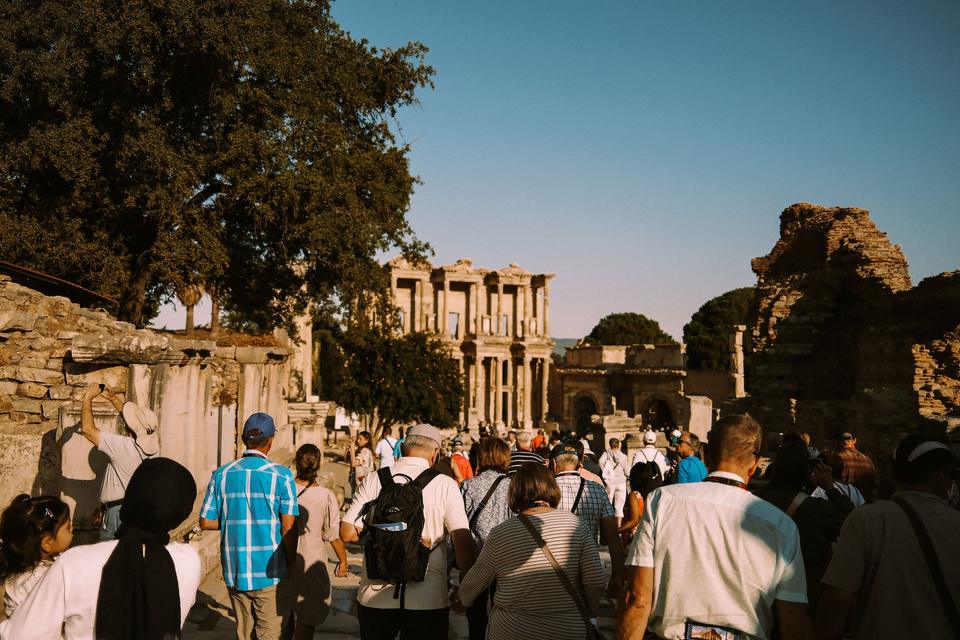
Most groups stop here for a few minutes: long enough for the inscription, the figures and the story. Then turn around for one of the best views in the site, straight down Curetes Street toward the Library of Celsus. There is almost no shade on this stretch, so keep water handy.
The accessible route enters and leaves by the Lower Gate and stays in the lower city, so it does not reach this square; our wheelchair access page explains what that route includes. Our Just Ephesus tour walks past the monument on the way down, and our walk through Ephesus puts every stop in order. If you would like more time with the carvings, tell us through our inquiry form and we will plan the pace around your ship's hours.
Questions cruise guests ask us
Is the Memmius Monument included in the Ephesus ticket?
Yes. It stands inside Ephesus Ancient City, so the standard Ephesus ticket covers it with no extra charge. Entrance tickets are not part of our tour price: we buy skip-the-line tickets in advance and you pay the official price. Our fees page lists the current amounts.
Who built the Memmius Monument?
It was set up for Gaius Memmius while he was governor of the province of Asia, sometime after 30 BC. Its inscription names him as the son of Gaius and the grandson of Sulla Felix, the Roman dictator. The monument honored him and three generations of his family.
How old is the Memmius Monument?
It dates from the second half of the first century BC, so it is a little over 2,000 years old, and it was already about 80 years old when the apostle Paul came to Ephesus.
Is the Memmius Monument the same as the Hercules Gate?
No. The Memmius Monument is the carved family monument on the north side of Domitian Square. The Hercules Gate is a few steps further down, at the head of Curetes Street: two pillars carved with figures of Hercules. Most walks pass both within a couple of minutes.
Can you see the Memmius Monument on the wheelchair route?
No. The accessible route enters and leaves Ephesus by the Lower Gate and stays in the flat lower city. The Memmius Monument is in the upper city, on Domitian Square, and the way down from it to the Lower Gate is long and uneven.
Read next



The sites
Tell us your ship. We will plan the day around it.
Send your ship name, date and all-aboard time, and we reply with a plan and an exact price within 24 hours.
Get My QuoteNo prepayment · Reply within 24 hours · TÜRSAB 15746
Prefer email? info@infoephesus.com
